
CAT 2026 Syllabus, Exam Pattern & Section-Wise Preparation Guide
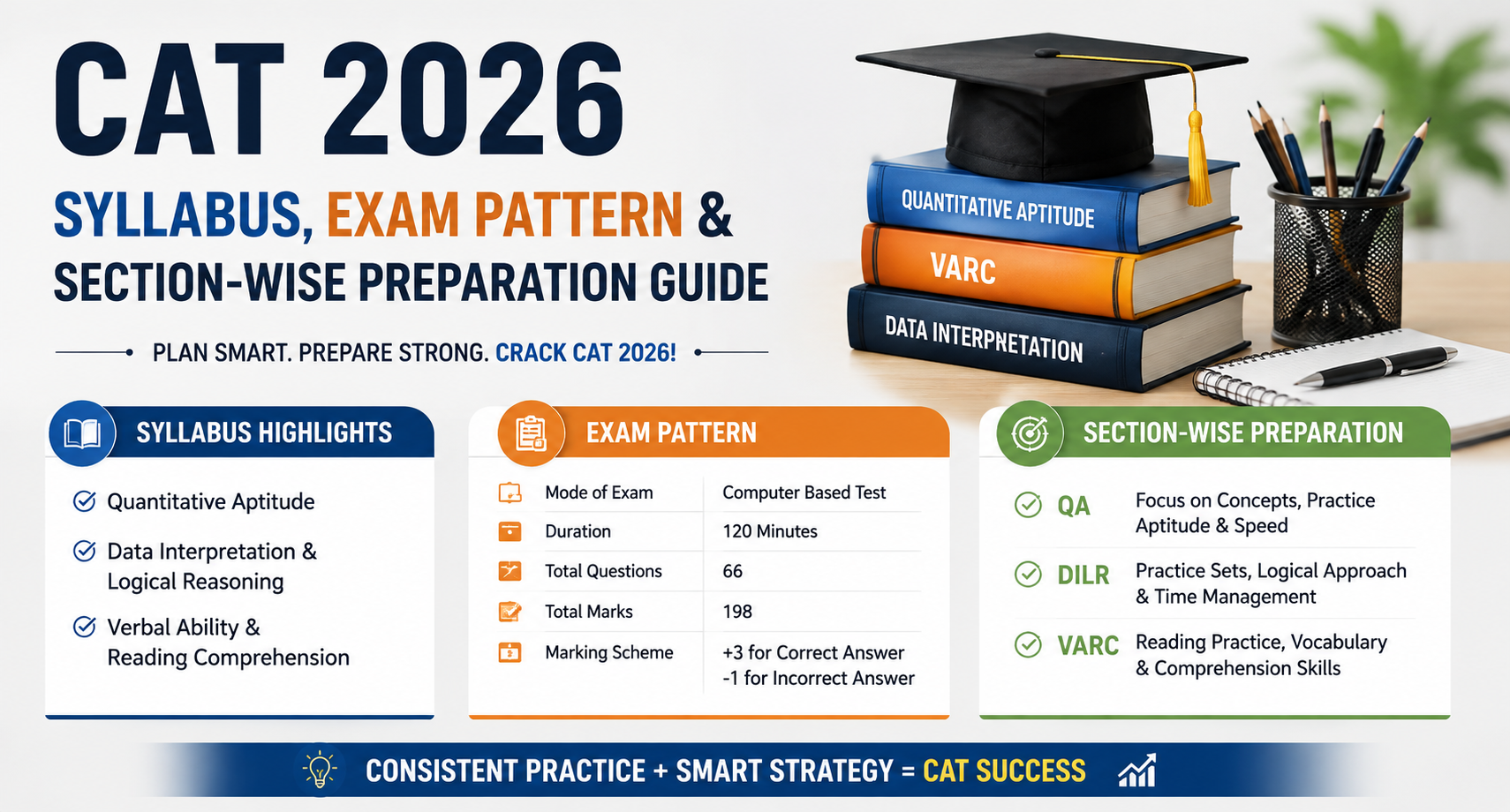
If you're preparing for the Common Admission Test (CAT), you've probably asked yourself one question repeatedly: "What exactly should I study for CAT 2026?" The answer isn't as straightforward as downloading a syllabus PDF. Unlike many competitive exams, CAT does not publish an exhaustive chapter-wise syllabus every year. However, one reassuring fact remains: the exam pattern and the topics tested have remained remarkably consistent over the years. With the official CAT 2026 notification expected in July/August 2026, aspirants who begin preparing early gain a significant advantage. A clear understanding of the syllabus allows you to prioritize high-weightage topics, avoid wasting time on low-yield areas, and build an effective preparation strategy.
In this guide, we'll break down the CAT 2026 Exam Pattern, discuss all three sections in detail, and share practical preparation tips to help you move closer to your goal of securing a 99+ percentile.
CAT 2026 Exam Pattern Overview
CAT is expected to follow its recent format with three sections and a sectional time limit.
| Particulars | Details |
|---|---|
| Exam Mode | Computer-Based Test (CBT) |
| Total Duration | 120 Minutes |
| Number of Sections | 3 |
| Time per Section | 40 Minutes |
| Expected Questions | 66–68 |
| Question Types | MCQs + TITA |
| Negative Marking | Applicable only to MCQs |
Quick Snapshot
- Section 1: Verbal Ability & Reading Comprehension (VARC)
- Section 2: Data Interpretation & Logical Reasoning (DILR)
- Section 3: Quantitative Aptitude (QA)
- Approximately 22–24 questions per section.
- Candidates cannot switch between sections before the allotted time ends.
One important thing to remember is that CAT is not merely a knowledge test—it's a test of decision-making, time management, and question selection.
CAT VARC Syllabus 2026
VARC is often considered the make-or-break section for many aspirants. While some students naturally gravitate toward language-based questions, others find it intimidating due to lengthy passages and unfamiliar topics.
Important Topics Reading Comprehension (RC) Reading Comprehension accounts for nearly 65–70% of the VARC section. Passages are usually drawn from:
- Philosophy
- Psychology
- Economics
- Sociology
- Science
- Literature
- Business and Technology
Verbal Ability
The remaining questions generally come from:
- Para Jumbles
- Para Summary
- Odd One Out
- Sentence Placement
Unlike school-level English examinations, CAT rarely tests direct grammar rules or vocabulary-based questions. Instead, it focuses on comprehension, logical flow, and interpretation.
Expert Tips for VARC
- Read Daily: Spend at least 30–45 minutes reading editorials, magazines, and long- form articles from diverse domains.
- Improve Reading Speed Gradually: Aim to read without subvocalizing (silently speaking each word in your mind).
- Build Contextual Vocabulary: Learn words through usage rather than memorizing dictionary lists.
What to Prioritize
- Reading Comprehension
- Para Summary
- Para Jumbles
What to Skip
- Spending excessive time memorizing obscure vocabulary lists.
- Over-focusing on grammar concepts that rarely appear directly in CAT.
CAT DILR Syllabus 2026
DILR is widely regarded as the most unpredictable section of CAT. Every year, this section surprises candidates—not because of difficult concepts, but because of the complexity of the sets.
Data Interpretation Topics
- Tables
- Bar Charts
- Line Graphs
- Pie Charts
- Mixed Graphs
- Caselets
Logical Reasoning Topics
- Seating Arrangements
- Blood Relations
- Venn Diagrams
- Games and Tournaments
- Scheduling
- Distribution Puzzles
- Network Diagrams
The biggest mistake candidates make is trying to study DILR theoretically. Unlike Quant, there isn't an extensive formula sheet to memorize.
Expert Tip for DILR
Practice complete sets—not individual concepts.
Aspirants targeting a 99+ percentile should solve:
- 3–4 DILR sets daily.
- Previous year CAT sets.
- Timed sectional tests every week.
The real skill lies in identifying which sets to attempt and which to leave. In CAT, solving two or three manageable sets accurately often leads to an excellent percentile.
What to Prioritize
- Arrangement-based puzzles
- Tables and charts
- Tournament and scheduling sets
What to Skip
- Spending hours mastering rare puzzle types with minimal historical occurrence.
CAT Quantitative Aptitude Syllabus 2026
Quantitative Aptitude remains one of the highest-scoring sections for candidates who prepare systematically. The good news? You don't need advanced mathematics to excel.
High-Weightage Topics Arithmetic Typically contributes the largest share of questions:
- Percentages
- Profit & Loss
- Ratio & Proportion
- Time & Work
- Time, Speed & Distance
- Averages
- Mixtures and Alligations
- Linear Equations
- Quadratic Equations
- Functions
- Inequalities
- Logarithms
- Progressions
- Triangles
- Circles
- Polygons
- Coordinate Geometry
- Number System
- Modern Mathematics
- Permutations & Combinations
- Probability
- Set Theory
Algebra
Geometry & Mensuration
Other Topics
Historically, Arithmetic and Algebra together account for nearly 70% of the Quant section, making them indispensable for aspirants.
Expert Tips for QA
- Focus on conceptual clarity before attempting shortcuts.
- Develop mental math skills for quicker calculations.
- Maintain a formula notebook for regular revision.
- Practice solving questions in multiple ways.
- Arithmetic
- Algebra
- Basic Geometry
- Blindly memorizing hundreds of formulas without understanding their application.
What to Prioritize
What to Skip
Remember: CAT rewards problem-solving ability, not rote learning.
Topic-Wise Weightage Table (Expected)
While IIMs do not officially release a chapter-wise syllabus or weightage distribution, previous CAT trends provide a reasonable estimate of the topics that appear most frequently.
| Section | Expected Questions |
|---|---|
| Reading Comprehension | 16–18 |
| Verbal Ability | 6–8 |
| DILR | 20–22 |
| Arithmetic | 8–10 |
| Algebra | 5–6 |
| Geometry | 2–4 |
Note: The figures above are based on recent CAT papers and are intended for planning purposes only. Actual weightage may vary in CAT 2026.
How to Score 99+ Percentile in CAT 2026
Students often believe that a 99+ percentile requires solving every question. That's a myth. Successful candidates typically:
- Attempt 65–75% of the paper.
- Maintain high accuracy.
- Analyze every mock test thoroughly.
- Identify strengths and weaknesses early.
- Build a sustainable preparation routine.
A good preparation framework includes:
| Activity | Frequency |
|---|---|
| Reading Practice | Daily |
| Quant Practice | Daily |
| DILR Sets | 3–4 Daily |
| Sectional Tests | Weekly |
| Full-Length Mocks | 1–2 Weekly (initially) |
| Mock Analysis | After Every Test |
6-Month CAT 2026 Preparation Plan
If you're wondering how to prepare for CAT 2026, a structured study plan can help you stay consistent and avoid last-minute stress.
| Month | Focus Area |
|---|---|
| June | Fundamentals and diagnostic tests |
| July | Concept building across all three sections |
| August | Intensive practice and topic-wise revision |
| September | Sectional tests and time management |
| October | Full-length mock tests and analysis |
| November | Revision, light mocks, and exam readiness |
This six-month roadmap aligns well with a practical CAT preparation strategy and ensures balanced coverage of concepts, practice, and revision.
Start today by creating a personalized study schedule, identifying your strongest and weakest sections, and taking your first sectional mock test this week. Every hour you invest now brings you one step closer to your dream B-school and a coveted 99+ percentile in CAT 2026.
Frequently Asked Questions
No. The conducting IIM does not publish an exhaustive chapter-wise syllabus. However, the topics tested in CAT have remained relatively consistent over the years.
As of now, no major changes have been announced for CAT 2026. Aspirants can expect a pattern similar to recent CAT examinations unless stated otherwise in the official notification.
For most candidates, DILR is considered the toughest section because of its unpredictable nature and the importance of selecting the right sets.
Most aspirants require 6–12 months of consistent preparation. However, the ideal timeline depends on your current aptitude level and target percentile.
Yes. Many candidates have achieved excellent percentiles with six months of focused preparation, provided they maintain consistency, take regular mock tests, and analyze their performance effectively.
Historically, Reading Comprehension, Arithmetic, Algebra, Tables & Charts, Seating Arrangements, Para Summary, and Para Jumbles have been among the highest-weightage topics in CAT.